Educational content only. Not advice about any product or health condition. Talk with your healthcare provider about your own health.
Download it free, to keep.
A Personal Note
This book did not arrive from a safe distance. It grew out of my own life, and out of many years in which my body was not something I understood but something I was simply trying to survive. For the better part of two decades I was seriously ill. There were long stretches when illness set the terms of my days—what I could eat, where I could go, whether I could make a plan and trust myself to keep it. At one point the path ahead narrowed to the point where major surgery was presented to me as the likely next step, and I had largely made my peace with the idea that this was simply how my life would go.
I will not set down the whole of that history here; this is a book about the body in general, not a chronicle of mine in particular. But a reader deserves to know where these ideas come from, because they did not come from a library alone. They came from the low points as much as the recoveries—from years of treatments that helped and treatments that did not, from being told that certain hard outcomes were likely, and then, slowly and against my own expectations, from finding my way toward a kind of health I had stopped believing was available to me. Somewhere in that long passage I stopped being only a patient resigned to my condition and became a student determined to understand it. Much of what I learned is gathered in these pages.
What changed my thinking was the discovery, made the hard way, that the body does not heal in pieces. For years I had searched for the single answer—the one treatment, the one fix—and my body kept refusing to work that way. When health finally began to return, it came not from any one dramatic intervention but from the patient tending of many things at once, each supporting the others, until the whole began to turn differently than it had before. That insight—that the body is a web of systems moving through a single cycle—is the spine of this book. I did not reason my way to it. I lived my way to it. In time, people who had known how sick I had been struggled to account for how well I had become; what had looked, from the outside, like a decline that would only continue had somehow reversed. I do not offer that as proof of anything. I offer it as the reason I could not stay quiet about what I had learned.
I offer what follows, then, not as a physician—I am not one—and not as a set of instructions, but simply as what I have come to understand, shared in the hope that it serves you as it came to serve me. My own recovery taught me that the body is far more capable of returning to balance than I had ever been led to believe, and that much of what helps it do so is quieter, humbler, and more within reach than we imagine. If any part of what follows helps even one reader meet their own body with more understanding and less fear, then the years that taught it to me will have been worth more than I can say.
“Ask me not what I was in the Past, ask me what I am in the Present.”
— Vijay K. Ahuja
Introduction: Why a Tiger
Most books about health begin with a promise. They name a problem—a stubborn symptom, a number on a chart, a feeling of running down—and they offer a solution, often a single one: this diet, this supplement, this routine, this fix. The appeal is obvious. A single cause is easy to understand, and a single solution is easy to sell. But anyone who has lived long inside a human body knows that this is rarely how health actually behaves. The body does not have one problem and one answer. It has many systems, all in conversation, and its troubles and its triumphs alike tend to emerge from how those systems work together.
This book takes the harder but truer path. It begins not with a promise of a quick fix but with an image: the tiger, an animal whose strength is unmistakable and yet, on close inspection, mysterious. A tiger is powerful, but its power is not the rigid, brittle strength of something built to be hard. It is supple. The same animal that can lie still for hours can explode into motion in an instant, and recover, and do it again. Its strength is not a fixed possession but a living capacity, maintained across a lifetime through a rhythm of effort and rest, challenge and repair. That rhythm—not the muscle, not the speed, but the cycle beneath them—is the real source of the tiger’s vitality.
Human health, this book argues, works the same way. Beneath the hundred concerns that occupy us—what to eat, how to sleep, whether to exercise, how to handle stress—runs a single underlying cycle, the same one that animates the tiger: a movement from disturbance to repair to adaptation to resilience, and finally to the lived abundance of vitality, which then feeds back into readiness for the cycle to begin again. To understand that cycle is to understand health not as a collection of separate problems but as a single, coherent process that can be supported or neglected as a whole.
❧
The book is built in two parts. The first lays out the architecture. It opens with the five movements of the cycle—Inflammation, Recovery, Adaptation, Resilience, and Vitality—examining each in turn, with attention to what is actually happening in the tissues. It then turns to the systems and practices through which the cycle is most directly supported or undermined in an ordinary life: the food on the plate, the community of microbes in the gut, the nervous system’s tides of arousal and calm, the body’s movement, its daily clock, its bonds with other people, its breath, its water, its handling of fuel, the sun it lives under, the frame that holds it up, and the sense of purpose that gives a person reason to tend any of it at all. It also looks honestly at the forces that wear the cycle down, and closes by drawing the whole architecture back together into a single, livable rhythm. Each of these is a lever within ordinary reach. Together they make up the practical work of living well.
The second part turns from principle to portrait. It offers a handful of stories—a recovery after surgery, a life of active aging, a meditation on recovery as a skill that can be learned—each showing the cycle at work in the texture of a real human life, and closes with a reflection on what it means, in the end, to live the cycle rather than merely understand it.
A word about how the science is handled here. The pages that follow draw on a great deal of current research, and they try to honor it honestly. Where the evidence is strong, it is stated plainly. Where it is preliminary, or mixed, or still debated, that too is said, because a reader is better served by honest uncertainty than by confident overstatement. The body is genuinely complicated, and much about it remains unsettled; pretending otherwise would be a disservice. The aim throughout is not to dazzle with certainty but to clarify—to make the ordinary machinery of living health visible enough that it can be cared for with understanding rather than anxiety.
Finally, a note on what this book is not. It is not a treatment plan, and it is not a set of rules. It will not tell anyone exactly what to eat on a given Tuesday or precisely how many minutes to exercise. Those particulars belong to each person and, where needed, to the professionals who know them. What this book offers instead is a way of seeing—a framework within which the countless specific choices of a life can be understood and weighed. The hope is that a reader who finishes it will look at their own body differently: not as a machine that breaks and must be fixed, but as a living system that can be tended, and that responds, over time, to the patient accumulation of ordinary care.
The qualities the tiger represents—resilience, adaptability, vitality—are not exotic gifts reserved for a fortunate few. They are the birthright of every living body, available in some measure to nearly everyone, expressed through the same cycle described in these pages. The work of this book is simply to make that cycle visible, so that it can be lived on purpose. The journey begins, as the tiger’s strength does, not with a single dramatic act, but with understanding the rhythm beneath it all.
Wellness In Balance™
Prologue: The Five Movements
“When Balance returns, Wellness begins.”
Picture the animal itself. A tiger at rest is a study in stillness—loose, unhurried, almost heavy with calm. The same animal a moment later is pure explosive motion, and a moment after that, at rest again, already recovering. Its power is never the rigid, braced strength of something built only to be hard; it is a supple, renewable strength, spent and restored in a rhythm so constant it has become the creature’s nature. What looks, from the outside, like raw force is in truth the visible result of an invisible cycle—challenge met, then recovered from, ten thousand times across a life.
This book takes that cycle as its subject, because the same rhythm runs beneath every human life, whether or not we notice it. We are not tigers, but we are built on the same ancient logic: a body disturbed, then repaired; challenged, then strengthened; worn, then restored. The strength available to a person—the kind that lasts, that bends without breaking, that can still be summoned in the eighth decade—is not a fixed possession either. It, too, is a living capacity, maintained across a lifetime by the turning of a cycle.
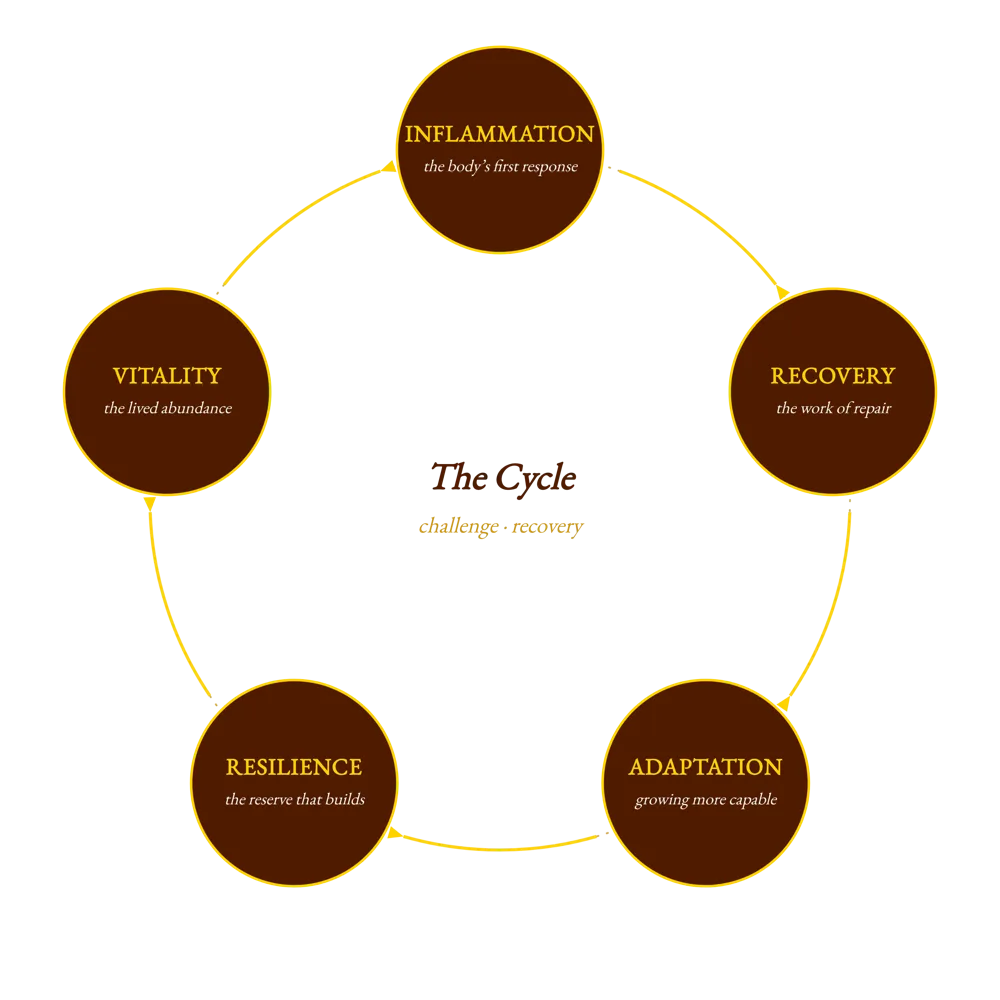
That cycle moves through five movements, and they give this book its spine. Inflammation is the body’s first response to disturbance; Recovery, the work of repair that follows; Adaptation, the way repeated challenge leaves the body more capable than before; Resilience, the deep reserve that adaptation accumulates; and Vitality, the lived experience of a body whose systems cooperate well. These are not five separate topics but five views of one continuous motion—the way a single wave can be spoken of by its rise, its crest, its fall, and the calm that follows.
❧
One feature of this shape matters above all: the five movements form a circle, not a ladder. Vitality is not a summit to be reached and held. It feeds directly back into the body’s readiness for the next disturbance, the next repair, the next adaptation. A person in good health is not someone who has escaped the cycle, but someone in whom it turns smoothly—and everything that follows is an attempt to show how that turning is helped or hindered.
Wellness In Balance™
Inflammation: The Body’s First Language
Inflammation has acquired a bad reputation, and the reputation is only half deserved. In ordinary conversation the word has come to mean something purely harmful, a fire to be put out as quickly as possible. But inflammation is, first of all, the body’s oldest and most reliable language for saying that something has happened. A splinter enters the skin. A virus breaches the airway. A muscle tears under load. In each case the same ancient response unfolds: blood vessels widen, immune cells arrive, signaling molecules summon reinforcements, and the affected region grows warm, red, and tender. This is not malfunction. This is the body mounting a defense and beginning repair.
Acute inflammation of this kind is indispensable. It clears damaged tissue, neutralizes invaders, and lays the groundwork for healing. Crucially, it is meant to end. A well-functioning inflammatory response is like a controlled burn: intense, purposeful, and brief. When the threat is handled, specialized signals call off the response, the immune cells stand down, and the tissue returns to its quiet working state. The whole episode resolves. That resolution is as much a part of healthy inflammation as the flare itself.
When the Fire Will Not Go Out
Difficulty arises when inflammation loses its off switch. Instead of flaring and resolving, it smolders—low in intensity, but continuous, and often without any obvious injury or infection to justify it. Researchers describe this state as chronic, low-grade, sterile inflammation. “Sterile” because there is no pathogen driving it. “Low-grade” because it rarely produces the dramatic heat and redness of an acute response. And yet, precisely because it is quiet and persistent, it can do a kind of damage that an acute flare never does. A controlled burn that never ends stops being a tool and starts being a hazard.
Much of what is now understood about this smoldering state has emerged from the study of aging. Over the past two decades, scientists have identified a phenomenon they call inflammaging: a chronic, low-grade systemic inflammation that tends to increase with age even in the absence of overt disease. It is marked by persistently elevated levels of pro-inflammatory signaling molecules and by the gradual accumulation of senescent cells—cells that have stopped dividing but refuse to die, and that leak a steady stream of inflammatory signals into the tissue around them. This background inflammation has been linked, in research settings, to many of the conditions associated with later life, from cardiovascular and metabolic disease to neurodegeneration and frailty.
It is worth being careful here. To say that chronic inflammation is associated with these conditions is not to say that it single-handedly causes them, nor that lowering it guarantees their prevention. The relationships appear to be bidirectional and tangled: inflammation can contribute to tissue decline, and declining tissue can in turn provoke more inflammation, each feeding the other in a self-reinforcing loop. The honest summary is that chronic inflammation is one of several deeply interconnected processes that shape how a body ages, not a single villain that explains everything.
The Sources of the Smolder
Where does persistent low-grade inflammation come from? Research points to several overlapping sources rather than one. Senescent cells are one contributor, broadcasting their inflammatory signals year after year. The aging immune system is another, gradually losing its precision and tending toward a baseline of low-level activation. The gut appears to matter a great deal: when the lining of the intestine becomes more permeable, fragments of bacteria can slip into the bloodstream and keep the immune system mildly provoked. Damaged cellular components—the debris of ordinary wear, including stressed mitochondria—can also trip the body’s alarm systems even when no outside threat exists.
These sources share a theme. Each represents a small disturbance that the body, for one reason or another, has not been able to fully resolve. Individually, none of them is catastrophic. Collectively, and over years, they can keep the inflammatory machinery running at a low hum. This is why the most promising approaches to chronic inflammation are rarely about a single dramatic intervention. They tend instead to involve the unglamorous fundamentals—sleep, movement, the quality of food, the health of the gut—that influence many of these sources at once.
The lesson of this first movement is therefore not that inflammation is the enemy. The lesson is that inflammation is information, and that the body’s intent is always to resolve it. Health is not a state with no inflammation in it. Health is a state in which inflammation arrives when it is needed, does its work, and then—this is the part that matters most—comes to an end. Everything that follows in the cycle depends on that ending, because the close of inflammation is the opening of recovery.
Recovery: The Architecture of Repair
If inflammation is the body’s response to disturbance, recovery is its response to inflammation. It is the quiet, patient work of putting things back in order—rebuilding tissue, clearing waste, restoring the chemical balance that effort and injury disrupt. Recovery is easy to overlook precisely because so much of it happens out of sight, while we are at rest and especially while we are asleep. We tend to credit our progress to our efforts. In truth, effort only creates the demand for change. The change itself is built during recovery.
David, whose story appears later, discovered this the hard way. His surgery succeeded, his surgeon was satisfied, and yet his recovery surprised him with its difficulty. Fatigue lingered. Sleep was uneven. His energy rose and fell without apparent reason. What he learned is a truth that millions encounter every year: a procedure may correct a specific structural problem, but the healing that follows draws on the entire body. Tissue must be rebuilt, which requires raw materials. The immune system must coordinate repair without overreacting. Movement must be reintroduced with judgment. None of this can be willed into happening faster. It can only be supported, and the most powerful support is sleep.
The Hidden Labor of Deep Sleep
Sleep is not a single uniform state but a sequence of stages, and one of them—the deep, slow-wave sleep that dominates the early part of the night—is the body’s principal window for physical repair. During these stages the brain’s electrical activity slows into long, synchronized waves, the heart rate settles, and the body shifts into its most restorative mode. It is during deep sleep that the body releases its largest pulses of growth hormone, the signal that drives tissue remodeling, muscle repair, and cellular renewal throughout adult life. This is not a metaphor for recovery. It is the machinery of recovery, operating on a nightly schedule.
Deep sleep also appears to perform a kind of housekeeping for the brain. Research on the glymphatic system—a waste-clearance pathway that becomes markedly more active during slow-wave sleep—suggests that the sleeping brain flushes away metabolic byproducts that accumulate during waking hours, including proteins associated with neurodegenerative disease. The spaces between brain cells appear to widen during this phase, allowing fluid to move through and carry waste away. In a real sense, the brain takes out the trash while we sleep, and it does so most efficiently in the deepest stages.
The hormonal environment of sleep reinforces all of this. As growth hormone rises, the stress hormone cortisol tends to fall, creating conditions that favor repair over breakdown and calm over alarm. Melatonin, beyond its familiar role in regulating the sleep-wake cycle, acts as an antioxidant that helps protect cells from oxidative damage. The picture that emerges from current research is of sleep as an actively managed restorative process, a nightly coordination of hormones and clearance systems aimed at undoing the day’s wear. When deep sleep is shortened—by alcohol, by late caffeine, by irregular schedules, by chronic stress—this restorative work is curtailed, and the evidence suggests that inadequate sleep tends to leave inflammation higher rather than lower.
Rest as an Active State
There is a deep irony in how recovery works. The most productive thing the body does, it does while appearing to do nothing at all. Recovery depends on the activation of the parasympathetic nervous system—the so-called rest-and-digest state—which is the physiological opposite of the fight-or-flight arousal that dominates a stressful day. The body cannot rebuild while it is braced for threat. Repair requires a stand-down, a genuine shift out of vigilance into restoration.
This reframes rest entirely. Rest is not the absence of activity; it is a different kind of activity, one the body cannot skip without consequence. A culture that treats rest as laziness and recovery as wasted time is, in effect, asking the body to adapt without ever giving it the conditions adaptation requires. The athlete who trains without recovering does not grow stronger; they grow more depleted. The person who works without resting does not accomplish more in the long run; they accumulate a debt that the body eventually collects.
When David shifted his attention to sleep quality, gentle movement, hydration, nourishment, and patience, his progress accelerated. The lesson was not that recovery could be hurried. It was that recovery could be supported, and that healing proceeds most effectively when the systems responsible for it are given what they need. This is the second movement of the cycle, and it sets up the third. For recovery does not merely return the body to where it was. Done well, it returns the body to a slightly stronger place than before—and that small surplus is the seed of adaptation.
Adaptation: The Logic of Challenge
Here is one of the most useful and least intuitive facts about living systems: a body that is never challenged does not stay the same. It declines. Muscles that are never loaded weaken. Bones that bear no stress lose density. A cardiovascular system that is never pushed becomes less capable. The body interprets the absence of demand as permission to economize, shedding capacity it apparently does not need. Comfort, pursued too completely, is a slow path to fragility.
The reverse is also true, and it is the engine of the entire cycle. When a body is challenged at the right intensity and then allowed to recover, it does not merely repair the damage—it overcompensates, building back slightly stronger than before in anticipation of future demand. This principle has a name in biology: hormesis, the phenomenon in which a mild or moderate stressor triggers a beneficial adaptive response. The key words are mild and moderate. Hormesis is not a license to seek out as much stress as possible. It describes a specific zone in which a challenge is large enough to prompt adaptation but small enough that the body can fully recover from it.
The Shape of the Dose
Everything in adaptation turns on dose. Researchers often describe the relationship between a stressor and its effect as a curve: at very low doses, a challenge may be too slight to disturb the body’s equilibrium at all, and nothing changes. At moderate doses—the hormetic zone—the challenge disrupts equilibrium just enough to provoke a constructive response, and the body adapts upward. But at high doses, the disruption exceeds the body’s capacity to recover, and the result is not adaptation but harm. The same stressor, in other words, can strengthen or injure depending entirely on its magnitude and on whether recovery is allowed to complete.
Exercise is the clearest example. A demanding workout is, at the cellular level, a controlled insult. Muscle fibers sustain microscopic damage. Metabolic byproducts accumulate. Reactive oxygen species—molecules often cast as agents of aging—are generated in abundance. Viewed in a single snapshot, the picture looks alarming. Yet these very disruptions are the signals that drive adaptation. The reactive oxygen species produced during exercise, for instance, appear to prompt the body to strengthen its own antioxidant defenses and repair systems. The temporary damage is the message; the lasting strength is the reply. This is also why blunting every exercise-induced stress—for example, by reflexively dosing antioxidants around training—may, according to some research, interfere with the adaptations that make the training worthwhile.
The same logic extends well beyond the gym. Brief, controlled exposure to heat, as in sauna use, and to cold, and the metabolic challenge of intermittent fasting have all been studied as potential hormetic stressors, each mildly perturbing the body in ways that may prompt protective adaptations. The details vary and the evidence is stronger for some than for others, but the underlying principle is consistent: living systems are built to respond to challenge, and a measured challenge followed by full recovery tends to leave them more capable than before.
Why Stress Is Not the Enemy
This third movement asks us to revise a common assumption. We are often told that stress is uniformly harmful and that the goal of a healthy life is to minimize it. The biology of adaptation tells a more nuanced story. The problem is not stress as such; the problem is the wrong dose of stress, or the right dose without recovery. A challenge that is too large, too constant, or never followed by genuine rest does indeed wear the body down. But a challenge that is appropriately sized and properly recovered from is the very thing that builds capacity. Some researchers prefer the word “challenge” to “stress” for exactly this reason, to keep the constructive case from being lost beneath the word’s grim associations.
This is why the cycle cannot be broken into pieces and still work. Adaptation depends absolutely on recovery; without it, challenge produces only depletion. And recovery, in turn, only matters because there is something to recover from. The two movements are partners. The athlete who understands this trains hard and rests deliberately, knowing that the gains are made not during the effort but during the restoration that follows. The same wisdom applies to a working life, a creative project, or the long project of aging well. Push, then restore. Disturb, then repair. Out of that rhythm, repeated faithfully, the body builds something durable—and that durability is the fourth movement.
Resilience: The Capacity to Return
Resilience is what adaptation accumulates into. If adaptation is the act of growing stronger in response to a single well-recovered challenge, resilience is the standing reserve that countless such episodes leave behind: the body’s overall capacity to absorb disturbance and return to balance. A resilient system is not one that never gets knocked off course. It is one that gets knocked off course and finds its way back—faster, more completely, and with more margin to spare than a fragile system could manage.
Researchers sometimes speak of a body’s “homeodynamic space”—the range within which it can maintain stable internal conditions despite changing demands from outside. A wide homeodynamic space means a body can handle a hot day, a missed night of sleep, a hard effort, or a minor illness without being thrown into disarray. A narrow one means small disturbances produce large consequences. One of the most striking findings in the study of healthy aging is that this space tends to shrink over the years—but that regular, moderate challenge, the hormetic kind, appears to help preserve it. Resilience, in this view, is not simply given by good genes or taken away by time. It is, in meaningful part, built and maintained through how a body is used.
Reserve Is Built Before It Is Needed
There is a sobering and clarifying truth at the heart of resilience: it must be built before the moment it is required. Maria, the aging athlete whose story appears later, understood this instinctively. Her ability to move well in her sixties rested on decisions made in her forties; her capacity to recover in her seventies depended on habits laid down decades earlier. When friends asked her secret, she always gave the same answer—consistency—because she grasped that resilience is not a thing one acquires in a crisis. It is a thing one deposits, steadily, in the years before the crisis arrives.
This is why resilience cannot be improvised. The reserve that carries a person through a serious illness, a major surgery, or simply the accumulating demands of age is built quietly, over a long time, through the ordinary repetition of challenge and recovery. Each well-recovered effort adds a little to the account. The deposits are individually unremarkable—a night of good sleep, a walk taken, a meal that nourished, a workout completed and recovered from. Their power lies entirely in their accumulation. The body keeps the ledger even when we forget it.
The same principle explains why resilience can erode without dramatic cause. A long stretch of poor sleep, chronic unrecovered stress, sustained inactivity, or persistent low-grade inflammation does not usually announce itself with a single catastrophic event. It withdraws from the account a little at a time, narrowing the homeodynamic space until a disturbance that once would have been absorbed easily instead produces a fall, a flare, or a slow decline. Resilience is lost the way it is built: gradually, through the quality of ordinary days.
The Gut as a Study in Resilience
The community of microbes that lives in the human gut offers a vivid illustration of resilience as a built and maintained property. A diverse, well-tended microbial community helps keep the intestinal lining intact, which in turn keeps bacterial fragments from leaking into the bloodstream and provoking the immune system. A diverse gut is, in effect, a buffer—a source of resilience for the whole body. When that diversity declines, the barrier can weaken, microbial fragments can cross into circulation, and the result can feed precisely the kind of chronic, low-grade inflammation described in the first movement.
What makes the gut such a useful example is that its resilience is so clearly shaped by daily inputs. The microbial community responds, day after day, to what it is fed and to the broader conditions of sleep, movement, and stress in which it lives. It is neither fixed at birth nor beyond influence. Like the body that houses it, the microbiome is built and maintained through the steady accumulation of ordinary choices—a small, living demonstration that resilience anywhere in the body tends to be earned the same way: not in a single decisive act, but in the patient repetition of conditions that allow a system to recover and adapt. And a body that has accumulated genuine resilience is, finally, free to express the thing all of this has been building toward: vitality.
Vitality: The Sum of the Cycle
Vitality is the hardest of the five movements to define and the easiest to recognize. We know it when we see it: in the person who moves through their day with energy to spare, who meets demands without being undone by them, who recovers quickly from setbacks and seems, somehow, fully alive. Vitality is not the mere absence of illness. A person can be free of any diagnosable disease and still feel depleted, brittle, and flat. Vitality is something more—a felt abundance of capacity, the lived experience of a body whose systems are cooperating well.
It is the natural consequence of the cycle turning smoothly. When inflammation arrives appropriately and resolves, when recovery is allowed to do its restorative work, when challenge is met at the right dose and adaptation follows, when resilience accumulates as a deep reserve—then vitality emerges, not as a separate achievement but as the sum of all the rest. This is why it makes no sense to pursue vitality directly, as though it were a destination one could reach by force of will. Vitality is downstream of the cycle. It is what a well-running cycle feels like from the inside.
And vitality is not the end of the story, because the cycle is a circle. A vital body is a body that is ready—ready to meet the next disturbance, to mount the next repair, to make the next adaptation, to add to the next reserve. Vitality feeds back into the body’s capacity for the cycle that produced it. There is no final state of health to be reached and then maintained unchanged. There is only the cycle, turning, and the quality of our participation in it. The Golden Tiger is powerful not because it has finished the work of becoming strong, but because it has never stopped doing the work.
❧
The chapters that follow turn from principle to portrait. They tell three stories—a recovery after surgery, a life of active aging, and a meditation on recovery as a learnable skill—each of which shows the five movements at work in an ordinary human life. They are followed by a closing reflection on what it means, in the end, to live the cycle rather than merely understand it. For the difference between knowing about the Golden Tiger and becoming the Golden Tiger is the whole of the matter, and it is made not in grand gestures but in the quiet accumulation of ordinary, well-chosen days.
Wellness In Balance™
The Plate as Medicine
Of all the levers that influence the cycle, none is pulled as often as the fork. A person eats three times a day, more or less, for a lifetime, which means that food is not an occasional intervention but a continuous one—a steady stream of information delivered to the body several times daily, year after year. This is worth pausing on. We tend to think of medicine as something taken when we are unwell, in measured doses, for a defined period. Food is the opposite: a constant input whose effects accumulate so gradually that we rarely connect a given meal to a given outcome. And yet, over years, the composition of that stream shapes the body more profoundly than almost anything else within our control.
To call food information rather than merely fuel is to make a real distinction. Fuel is a matter of quantity—calories to be burned. Information is a matter of content—signals that instruct the body’s systems. The same number of calories can carry wildly different instructions depending on what delivers them. A meal can quiet inflammation or provoke it, feed the gut’s beneficial microbes or starve them, supply the raw materials for repair or leave repair under-resourced. The body is always reading what we eat, and it adjusts accordingly. The question is never only how much we eat, but what we are telling the body when we do.
The Materials of Repair
The recovery described earlier—the rebuilding of tissue, the nightly remodeling driven by growth hormone—cannot proceed without raw materials, and the most important of these is protein. Muscle, in particular, is in a constant state of turnover, broken down and rebuilt continuously, and the balance between the two depends in part on an adequate supply of the amino acids that protein provides. This matters at every age, but it matters acutely in later life, when the body’s efficiency at building muscle declines and the loss of muscle mass and strength—a condition known as sarcopenia—becomes one of the central threats to independence and resilience.
Here the cycle’s interconnection becomes concrete. Recall that chronic, age-related inflammation tends to interfere with the body’s anabolic signaling—the very machinery that builds muscle. This means that the same inflammatory background that defines inflammaging can blunt the body’s response to both protein and exercise, making it harder to maintain the muscle that resilience depends on. Nutrition, inflammation, and physical activity are not three separate concerns but three faces of a single problem: the problem of keeping the body’s capacity to rebuild itself intact as the years accumulate. Food supplies the materials; exercise supplies the demand; controlled inflammation, neither too much nor too little, keeps the response intact.
The Quiet Power of Plants
If protein supplies the materials of repair, a second class of compounds appears to influence the conditions under which repair happens. Polyphenols—the bioactive compounds that give plants their deep colors and that are abundant in berries, grapes, tea, cocoa, and a wide range of vegetables, herbs, and spices—have drawn sustained scientific interest for their anti-inflammatory and antioxidant properties. In research settings, polyphenol-rich diets have been associated with reductions in markers of inflammation and with support for healthy aging, and the effects appear to run partly through the gut, where these compounds help shape the microbial community in beneficial directions.
The evidence here deserves an honest reading. Much of the most detailed mechanistic work comes from laboratory and animal studies, and the human trials, while encouraging, are often short and their results mixed. A recurring and instructive finding is that whole dietary patterns rich in these compounds—the broad family of traditional, largely plant-centered diets—show more consistent benefit than isolated supplements do. Indeed, studies of exercise repeatedly find that the training itself is the dominant adaptive stimulus, and that piling on antioxidant supplements does not reliably amplify it and may even interfere with it. The signal that emerges is not “take this compound” but “eat this way”: a variety of whole, minimally processed plant foods, eaten consistently, across a lifetime.
And here is the strange part, the one that turns the whole picture on its head: much of what food does for the body, it does only after passing through the hands of something else entirely—the vast, hidden population of microbes that lives in the gut, and that treats every meal as its own.
The Inner Garden
There is a community living inside every human being so vast that its cells rival our own in number. The trillions of microbes that inhabit the gut—the gut microbiota—are not passengers along for the ride. They are active participants in our biology, performing tasks the body cannot perform for itself, and their collective health is now understood to be deeply entangled with our own. To tend this community well is to tend a kind of inner garden: a living ecosystem that flourishes or falters according to how it is cared for, and that returns the favor in either direction.
The garden metaphor is apt because the gut microbiota behaves like an ecosystem rather than a machine. Its defining virtue is diversity. A varied community, rich in many different species, tends to be stable and resilient, able to resist disturbance and recover from it. A depleted community, dominated by few species, is fragile and more easily thrown into the disordered state researchers call dysbiosis. As in any garden, what matters is not a single prized plant but the health of the whole—the richness, the balance, the capacity of the system to maintain itself against the pressures that would simplify it.
The Currency of the Gut
The most important thing the gut’s microbes do for us, they do by eating what we cannot. Dietary fiber—the part of plant foods that human digestion leaves largely untouched—is fermented by these microbes in the colon, and the products of that fermentation are a family of compounds called short-chain fatty acids, chief among them butyrate, propionate, and acetate. These molecules are the currency through which the inner garden pays its keeper. They are, by current understanding, central to the relationship between what we eat and how the whole body fares.
Butyrate, the most studied of the three, is remarkable in its reach. It serves as the primary energy source for the cells lining the colon—by some estimates supplying the great majority of their fuel—and in doing so it helps maintain the integrity of the intestinal barrier itself. That barrier is the thin wall described in the first movement, the one whose weakening allows microbial fragments to leak into the bloodstream and stoke chronic inflammation. By nourishing the barrier and helping its cells knit tightly together, butyrate works directly against the kind of low-grade inflammation that drives inflammaging. Beyond the gut, short-chain fatty acids act as signaling molecules that help regulate immune function and temper inflammatory responses throughout the body. They are, in a sense, the chemical handshake between diet and immunity.
This is the mechanism that ties the previous chapter to this one. When we eat a variety of fiber-rich plants, we are not only feeding ourselves; we are feeding the microbes that produce these protective compounds. When we eat a diet stripped of fiber, those microbes are starved, their numbers fall, and the production of butyrate and its relatives declines—with consequences that ripple outward to the barrier, the immune system, and the body’s inflammatory tone. The plate and the garden are a single system. What lands on the one is, within hours, the diet of the other.
Tending the Garden
If the gut is a garden, then the principles of good gardening apply. The first is to feed it well: a diverse range of whole plant foods supplies the varied fibers that a varied microbial community needs. Monotony in the diet tends to produce monotony in the garden; variety encourages richness. The second principle is to avoid needless harm. Certain disruptions—including the use of antibiotics, which clear beneficial species along with harmful ones—can simplify the community, and while such interventions are sometimes medically necessary, they are not without ecological cost to the inner garden.
The third principle is the one most easily forgotten: the garden does not live in isolation from the rest of the body. Its condition is shaped not only by what we eat but by how we sleep, how we move, and how we manage stress. The gut and the nervous system are in constant two-way communication, and the state of one influences the other. This is why the inner garden cannot be tended by diet alone, and why the next system this account turns to—the nervous system, with its tides of arousal and calm—turns out to be inseparable from everything that has come before. The garden’s keeper is not only the fork. It is the whole pattern of a life.
The Skin Knows
There is a part of the body that cannot hide how the rest of it is doing. The skin is the one organ we see every day, in every mirror, and it has a quiet habit of reporting on the state of things beneath it. A hard week shows up on the face before we admit it to ourselves. A stretch of poor sleep, rich food, and unrelenting stress leaves its mark on the surface. We tend to treat skin as a thing apart, to be managed from the outside with what we apply to it. But the skin is not a separate territory. It is the visible surface of an inner condition, and learning to read it is learning to read the body as a whole.
This is not a matter of vanity. The skin is the body’s largest organ and its frontier with the world, a living barrier that keeps moisture in and threats out, that houses a dense population of immune cells, and that carries its own microbial community much as the gut does. When the skin looks clear, calm, and luminous, it is usually reporting that the systems feeding it are in good order. When it looks dull, irritated, or inflamed, it is often the first place that a deeper imbalance becomes visible. The old phrase “beauty from within” turns out to be more literal than it sounds: the surface reflects the interior, and the interior is shaped by everything this book has described.
The Conversation Between Gut and Skin
One of the more striking discoveries of recent research is that two organs as seemingly unrelated as the gut and the skin are in constant communication. Scientists now speak of the gut-skin axis: a bidirectional network linking the community of microbes in the intestine, the immune system, and the health of the skin. The gut and the skin would appear to have little to do with one another, separated as they are by the whole interior of the body. Yet the balance of the gut, through the immune and inflammatory signals it sends, appears to influence the condition and even the appearance of the skin, and the relationship runs in both directions.
The mechanism will be familiar from earlier chapters, because it runs along the same pathways. Recall the short-chain fatty acids—butyrate chief among them—that the gut’s microbes produce when they ferment fiber, and that help seal the intestinal barrier and temper inflammation throughout the body. These same compounds are part of what connects the gut to the skin: by calming systemic inflammation and supporting immune balance, a well-fed microbial community helps create the conditions in which skin can look its best. When the gut’s balance is disturbed instead—when its diversity falls and its barrier weakens—the low-grade inflammation that results does not stay in the gut. It travels, and the skin is one of the places it can surface, in dullness, redness, or irritation.
An honest word about the evidence is in order, because this is a young and fast-moving field. Much of the strongest research on the gut-skin axis comes from the study of specific skin conditions—eczema, acne, psoriasis, rosacea—where disturbances in the gut have been repeatedly linked to inflammation in the skin. The leap from there to everyday radiance in a healthy person is reasonable and biologically plausible, but it rests more on the underlying mechanism than on long-term trials of complexion itself. What can be said with confidence is modest and useful: the same inner balance that serves the whole body also tends to serve the skin, and the gut is one of its important levers.
The Glow Is Built, Not Applied
If the skin reflects the interior, then the practices that support radiant skin are, for the most part, the practices that support the body as a whole—and they will by now feel familiar. Two forces, more than almost any other, shape how vibrant skin looks over time: the body’s inflammatory balance and its defenses against oxidative stress. Everyday life generates a steady stream of oxidative stress—from sun, from pollution, from stress itself, from imperfect sleep—and over the years this wear can show on the surface as dullness and the visible signs of aging. Supporting the body’s healthy inflammatory response and its antioxidant defenses helps protect the vitality the skin already has.
This reframes the whole project of caring for skin. It does not mean abandoning what one applies to the surface; moisturizers, sun protection, and the rest do real and valuable work, and nothing here is a substitute for them. It means recognizing that the surface and the interior are two halves of one picture. The plants that supply polyphenols and antioxidants, the fiber that feeds the gut, the sleep during which tissue is repaired, the movement that lowers inflammation, the water that is the medium of every cell, the calm that settles the nervous system—each of these reaches the skin as surely as it reaches anything else, because the skin is fed by the same blood and governed by the same balance. Radiance, like resilience, is less a thing applied than a thing built, accumulated quietly through the ordinary care of the body beneath it.
And so the skin takes its place in the cycle not as an exception but as its most visible expression. What the skin shows, on a good day, is simply what a well-tended body looks like from the outside—the surface of a system in balance. To read it kindly, and to care for what lies beneath it, is to tend the whole. The same can be said of the system that governs whether the body is braced or at ease, and it is to that inner tide that the next chapter turns.
The Tide of the Nervous System
Beneath every other system runs a tide. The autonomic nervous system—the part of the nervous system that operates below conscious control—governs a fundamental rhythm in the body, a movement between two states that shapes everything from the heartbeat to digestion to the capacity for repair. On one side is the sympathetic branch, the engine of arousal: the fight-or-flight response that prepares the body to meet a threat, raising the heart rate, releasing stress hormones, and diverting resources toward immediate action. On the other is the parasympathetic branch, the agent of calm: the rest-and-digest state that allows the body to settle, restore, and rebuild. Health depends not on living permanently in either state but on the tide moving freely between them.
This rhythm is the hidden hinge of the entire cycle. Recall that recovery requires the parasympathetic state—that the body cannot rebuild while it is braced for threat. The autonomic tide, then, is what determines whether the conditions for recovery are present at all. A body that can shift readily into parasympathetic calm after a challenge is a body that can recover, adapt, and accumulate resilience. A body stuck on the sympathetic side—chronically aroused, never fully standing down—is a body in which the cycle cannot complete, because the restorative half of it is perpetually postponed.
The Stress Axis and Its Costs
Closely bound up with this tide is the body’s principal hormonal stress system, known by the regions that compose it: the hypothalamic-pituitary-adrenal axis, or HPA axis. When the brain perceives a stressor, it sets off a cascade—the hypothalamus signals the pituitary, which signals the adrenal glands, which release cortisol, the body’s primary stress hormone. In its proper form this response is elegant and self-limiting: cortisol mobilizes the body to cope, then feeds back to switch the system off once the threat has passed. Like acute inflammation, the acute stress response is meant to flare and resolve. It is a tool, and a good one.
The trouble, once again, lies in persistence. When stress is chronic—when the system is activated repeatedly or never allowed to fully reset—the elegant response becomes a source of wear. Researchers describe this accumulated cost as allostatic load: the cumulative strain on the body’s stress-regulating systems from prolonged or repeated activation. The signature of this dysregulation can be seen in the daily rhythm of cortisol itself, which normally rises sharply in the morning and falls toward night; under chronic stress this rhythm can flatten or invert, with cortisol lingering high in the evening when it should be low. And because elevated nighttime cortisol interferes with the deep sleep that growth hormone and repair depend on, chronic stress strikes directly at recovery—suppressing the very process that would otherwise restore the system.
The damage radiates outward through the connections already traced. Sustained sympathetic activation and elevated cortisol tend to reduce the parasympathetic regulation of inflammation, allowing inflammatory processes to run less checked—linking chronic stress back to the first movement of the cycle. Chronic stress also alters the gut: it can change motility, shift the microbial community, and increase the permeability of the intestinal barrier, tying the nervous system directly to the inner garden. No system stands alone. The tide that governs arousal and calm reaches into inflammation, recovery, and the microbiome alike.
Restoring the Tide
The encouraging side of this picture is that the autonomic tide is not entirely beyond our influence. A central player in the parasympathetic branch is the vagus nerve, the long, wandering nerve that connects the brain to the heart, the gut, and much of the body’s interior, and that carries the signals of calm. The strength of its activity—often discussed under the term vagal tone—serves as a rough index of how readily the body can shift into its restorative state. Higher vagal tone is associated with better recovery; lower vagal tone, with the stuck-on-alert pattern that chronic stress produces.
What can raise it tends to be familiar, because it is woven through everything in this account. Slow, deliberate breathing engages the vagus and shifts the autonomic balance toward calm. Regular physical activity—the hormetic challenge of the adaptation chapter—improves autonomic regulation over time. Adequate sleep restores the rhythm; time in nature has been associated with increased vagal tone and lower cortisol; and the quieting of chronic, unnecessary arousal gives the parasympathetic side room to operate. These are not separate techniques to be bolted onto a life. They are the same fundamentals—movement, sleep, nourishment, recovery—seen from the angle of the nervous system.
This is the deepest lesson of the tide. The nervous system is not one more item on a list of things to manage; it is the state within which every other kind of repair either can or cannot happen, the gatekeeper standing between challenge and recovery. Learn to let it settle—through breath, through movement, through sleep, through the company of others—and the whole cycle is given room to turn. It is a theme worth holding onto, because it will only deepen as the remaining threads are drawn out: the movement that signals the body to grow, the clock that times its every process, and the bonds with other people that prove as bodily as breath.
Wellness In Balance™
The Moving Body
The adaptation chapter introduced exercise as the clearest example of hormesis—a controlled challenge that, properly recovered from, leaves the body stronger. But to leave the matter there would be to understate it badly. Movement is not merely one stressor among many, useful for building muscle and stressing bone. It is, by a growing body of research, one of the most powerful signals the body can receive, with effects that reach far beyond the muscles that produce it. The moving body is a body in conversation with itself, and the language it speaks turns out to be chemical.
For most of medical history, skeletal muscle was understood simply as the machinery of motion—tissue that contracts to move bone, and little more. That picture has been overturned. Muscle is now recognized as an endocrine organ in its own right: a tissue that, when it contracts, secretes a family of signaling molecules called myokines into the bloodstream, where they travel to distant organs and influence how those organs behave. Every time a muscle works, it is not only moving the body; it is sending messages to the brain, the liver, the fat tissue, the immune system. Exercise, in this light, is a way of dosing the entire body with a particular set of instructions.
The Messengers of Movement
The myokines released during exercise have wide-ranging effects, and research continues to map them. Some appear to act against inflammation: muscle-derived interleukin-6, for instance, behaves quite differently when released by contracting muscle than the same molecule does in chronic inflammation, and is associated with anti-inflammatory effects, including the promotion of other anti-inflammatory signals. Others influence metabolism, helping regulate how the body handles glucose and fat. Still others, including a molecule called irisin, appear to support the creation of new mitochondria—the cellular power plants whose decline is one of the recognized hallmarks of aging. In effect, the working muscle helps the body renew its own capacity to produce energy.
Perhaps the most striking line of research concerns the muscle-brain axis. Among the myokines and related factors associated with exercise is brain-derived neurotrophic factor, or BDNF—a molecule that supports the survival of neurons, the formation of new connections between them, and the birth of new cells in the hippocampus, a brain region central to memory and learning. The precise routes by which exercise raises BDNF are still being worked out, and not every claim in this fast-moving field is settled, but the broad association between physical activity and brain health is among the more robust findings in the literature. Aerobic training has been linked, in human studies, to measurable increases in the volume of the hippocampus. The body’s movement, it appears, helps build the brain.
This reframes exercise entirely. It is not a chore performed for the sake of appearance, nor even only a way to build strength and stamina. It is a systemic signal—a means of instructing the body to reduce inflammation, renew its energy machinery, and maintain the brain. The phrase “use it or lose it” turns out to be more literally true than it sounds. A body that moves is a body continually receiving the message to maintain itself. A body that does not move stops receiving that message, and begins, in the way described in the adaptation chapter, to economize on capacities it apparently no longer needs.
Movement as a Daily Signal
If movement is a signal, then the relevant question is not only how hard one trains but how regularly the signal is sent. The research on myokines suggests their release follows patterns tied to the intensity and type of activity, but the larger lesson of the cycle holds here as everywhere: consistency matters more than intensity. Maria, the aging athlete, did not maintain her capacity through occasional heroic efforts. She maintained it by sending the signal often—walking, lifting, moving through a full range of motion—across years. The dose that builds resilience is not a single large one but a steady stream of moderate ones, each followed by recovery.
There is a catch, though, and it is a subtle one. The body does not read this signal, or any other, in a vacuum. It reads everything against an internal sense of time—a clock, running in nearly every cell, that decides when each process is meant to happen at all. And a signal sent at the wrong hour is not the same as one sent at the right.
The Body’s Clock
Everything the body does, it does on a schedule. Beneath the systems already described runs a timekeeper so fundamental that it is built into the machinery of nearly every cell: the circadian clock, the roughly twenty-four-hour rhythm that governs when biological processes rise and fall across the day and night. This is not a vague tendency to feel sleepy at night and alert in the morning. It is a precise molecular oscillation, driven by a small set of clock genes whose activity rises and falls in a self-sustaining loop, generating a daily cycle of gene expression that touches metabolism, hormone release, digestion, immune function, and repair.
The system is organized as a hierarchy. A master clock in the brain, set primarily by light, keeps overall time and synchronizes a vast network of peripheral clocks distributed throughout the body—in the liver, the pancreas, the gut, the muscles, and elsewhere. When all these clocks are aligned, both with one another and with the external day, the body runs in coordinated order, each process timed to occur when conditions favor it. Digestion is primed when food is expected. Repair is scheduled for rest. Alertness peaks during the active hours. Health, in this dimension, is a matter of timing—of the right processes happening at the right hour.
The Cues That Set the Clock
The clocks are set by environmental signals that researchers call zeitgebers, a German word meaning “time-givers.” The most powerful of these is light, which sets the master clock in the brain: bright light signals day, darkness signals night, and the system calibrates itself accordingly. But light is not the only cue. The timing of meals is a powerful zeitgeber for the peripheral clocks, particularly in the organs of metabolism. Food arriving at the expected hours reinforces the rhythm; food arriving at odd hours can pull the peripheral clocks out of step with the master clock in the brain.
This is where modern life collides with ancient biology. For nearly all of human history, the cues were consistent: bright days, dark nights, food during daylight. Electric light, screens that glow after sunset, food available at every hour, shift work, and travel across time zones have shattered that consistency. The result is what researchers call chronodisruption—a state in which the body’s clocks fall out of alignment with the external world and with one another. Light at night when the body expects darkness, and meals at night when the metabolic organs expect rest, are among the most common sources. The internal orchestra, in effect, loses its conductor, and the sections begin to play out of time.
The consequences are not trivial. Circadian disruption has been associated, across animal and human studies, with impaired metabolic health and a heightened vulnerability to a range of conditions. The mechanisms are still being clarified and the picture is genuinely complex—this is an active and unfinished area of science—but the broad principle is well supported: a body whose internal timing is scrambled does not function as well as one whose clocks are aligned. Notably, the disruption reaches the gut as well, where the timing system helps govern the intestinal barrier, immune activity, and even the rhythms of the microbiome, tying the clock directly to the inner garden of an earlier chapter.
Keeping Time
The practical implications follow directly from how the system works, and they are refreshingly concrete. Because light sets the master clock, getting bright light early in the day and dimming light in the evening helps keep the rhythm anchored. Because meal timing sets the peripheral clocks, eating in alignment with the daylight hours—and avoiding heavy food late at night—helps keep the metabolic organs in step. Because the system thrives on regularity, consistent timing of sleep, meals, and activity reinforces the whole. The clock, like the rest of the body, responds to consistency.
What is striking is how this dimension reframes habits that might otherwise seem unrelated to health. A late-night meal is not only a matter of calories; it is a mistimed signal to the metabolic clocks. Bright screens at midnight are not only a matter of lost sleep; they are a false dawn delivered to a brain expecting darkness. The body is always asking what time it is, and it reads the answer from light and food and activity. To live in rough alignment with the natural day is to let every system run on the schedule it evolved to keep. And among the rhythms most easily disturbed by disordered time—and most restorative when protected—is sleep, the great repair process whose partner, it turns out, is not only the clock but other people.
The Web of Connection
It would be possible to read everything so far as a profoundly solitary account of health—a matter of what one eats, how one moves, when one sleeps, how one manages stress. But this would miss something that the evidence has made increasingly difficult to ignore: human beings are social organisms, and the quality of our connections to other people is not merely a matter of happiness or circumstance. It is a physiological force, with measurable effects on inflammation, on the cardiovascular system, on the brain, and on how long we live. Connection belongs in this account not as a sentimental addition but as a system in its own right.
The scale of the effect is what makes it impossible to set aside. Research synthesized across large populations has found that social isolation and loneliness are associated with a substantially increased risk of early death—an effect that researchers have repeatedly compared, in magnitude, to well-established hazards such as smoking and obesity. In 2025 the World Health Organization’s Commission on Social Connection brought global attention to the issue, estimating that loneliness is associated with hundreds of thousands of deaths each year and framing social disconnection as a defining public-health challenge of the age. Whatever else health is, it is not purely an individual achievement. It is woven, in part, from our ties to others.
How Connection Reaches the Body
The question that makes this more than an epidemiological curiosity is the mechanistic one: by what route does something as intangible as loneliness reach the tissues? The answer ties the web of connection back into every system this account has described. Chronic loneliness and social isolation are associated with elevated levels of the same inflammatory markers—interleukin-6 and C-reactive protein among them—that appear in the story of inflammaging. Social disconnection, in other words, appears to register in the body partly as inflammation, the very process named in the first movement of the cycle. The lonely body and the inflamed body share a chemical signature.
The pathways extend further. Loneliness has been associated with heightened physiological stress—raised blood pressure and stress-hormone activity—which connects it directly to the HPA axis and the autonomic tide of an earlier chapter. It is also bound up with sleep: research suggests that lonely individuals tend to sleep more poorly, with more fragmented sleep, in a relationship that runs in both directions, since poor sleep can deepen feelings of loneliness in turn. One proposed explanation is that the socially isolated brain remains subtly vigilant, never fully lowering its guard, even at night. Connection, or its absence, thus reaches into inflammation, stress, and recovery alike. It is not a system apart; it is a system entangled with all the others.
It is worth stating the relationships honestly. Much of this evidence is observational, and the causal arrows are tangled: poor health can lead to isolation as surely as isolation can damage health, and the two often reinforce each other. The relationship is bidirectional, and no single study proves that loneliness alone causes disease. But the consistency of the association across many large studies, and the plausibility of the biological pathways, make a strong case that social connection deserves to be treated as a genuine determinant of health rather than a soft extra.
Connection as Nourishment
If disconnection registers in the body as a kind of harm, then connection appears to act as a buffer—a source of protection against the very stressors it counteracts. Strong social ties have been associated with lower inflammation, better cardiovascular outcomes, and greater longevity. The presence of others who matter to us, and to whom we matter, seems to help the nervous system settle, to dampen the chronic vigilance that drives so much physiological wear. In the language of this account, connection helps the autonomic tide move toward calm, and calm is the precondition for repair.
This places relationship alongside food, movement, and sleep as a fundamental input to the cycle—one as deserving of deliberate attention as any nutrient or exercise. It is easily neglected precisely because it does not feel like health maintenance. Time with people we care about presents itself as leisure, or as obligation, rarely as something the body requires in the way it requires protein or rest. Yet the evidence suggests it is exactly that. To tend one’s connections is to tend one’s biology. The web of connection is not separate from the moving body, the inner garden, or the autonomic tide; it is the social dimension of the same single fabric. Three threads remain, the most intimate of all—the breath that runs through every moment, the water that fills every cell, and the flexible flame of metabolism that turns out to be adaptability itself.
Wellness In Balance™
The Breath as Bridge
Among all the body’s automatic processes, breathing occupies a singular place. The heart beats without our permission; the gut digests without our attention; hormones rise and fall beyond our awareness. We cannot, by an act of will, slow the release of cortisol or quicken the repair of a wound. But breathing is different. It runs automatically, hour after hour, requiring no thought—and yet, at any moment, we can take hold of it, slowing it, deepening it, shaping its rhythm. Breath is the one major function that belongs to both the voluntary and the involuntary worlds at once. This dual citizenship is what makes it a bridge.
The bridge leads somewhere consequential. Recall the autonomic tide of an earlier chapter—the movement between sympathetic arousal and parasympathetic calm that determines whether the body is braced for threat or free to repair. That tide is, for the most part, not under conscious control. We cannot simply decide to shift into the restorative state. But because breathing is wired into the same autonomic machinery, and because we can control breathing, the breath offers a rare handle on a system that is otherwise out of reach. By changing how we breathe, we can nudge the autonomic balance itself. The breath is the lever by which the conscious mind reaches into the unconscious body.
The Rhythm of Heart and Lung
The mechanism behind this is visible in a phenomenon that has fascinated physiologists for well over a century. The heart does not beat at a perfectly even pace; its rate rises slightly with each inhalation and falls with each exhalation, in a gentle oscillation that follows the breath. This is called respiratory sinus arrhythmia, and despite the alarming word “arrhythmia,” it is entirely normal and, in fact, a sign of health. It arises chiefly from the rhythmic activity of the vagus nerve—the great nerve of the parasympathetic system—whose calming influence on the heart waxes and wanes with each breath.
The degree of this beat-to-beat variation is one expression of what researchers measure as heart rate variability, which serves as a rough window onto the activity of the vagus nerve and the flexibility of the autonomic system as a whole. A heart that varies readily with the breath tends to reflect strong vagal influence and good autonomic adaptability; a heart that beats with rigid uniformity tends to reflect the opposite, and diminished variation is associated with conditions such as chronic heart failure and hypertension. The breath and the heart are coupled, and the quality of that coupling is a quiet indicator of how well the body can shift between exertion and rest. Endurance athletes, notably, tend to show this variation in pronounced form.
Breathing the Body Toward Calm
What gives this practical force is a consistent finding from the research on slow breathing. When a person breathes slowly and deliberately—at a pace of roughly five to six breaths per minute, far slower than the unconscious default—the oscillation of the heart with the breath becomes more pronounced and measures of vagal activity reliably rise. Slow, paced breathing, in other words, appears to shift the autonomic balance toward the parasympathetic, calming side. The act of breathing slowly is, in effect, a way of telling the nervous system that there is no emergency—and the nervous system, reading the signal, tends to comply.
This is why slow breathing recurs across so many of the world’s contemplative and movement traditions, and why it has drawn sustained scientific interest as a simple, non-invasive way to support autonomic regulation and stress resilience. The evidence base is still maturing—the studies are often small, and researchers rightly call for larger and longer trials—but the underlying physiology is well established and the practice carries essentially no cost or risk. A few minutes of slow, even breathing asks nothing but attention, and it engages a mechanism wired into the body’s deepest regulatory systems.
The breath, then, is more than the exchange of oxygen for carbon dioxide. It is a control surface—the one place where a deliberate act reaches directly into the autonomic tide that governs recovery, inflammation, and rest. Every other lever in this account works indirectly and over time: food shifts the gut over days, movement builds capacity over weeks, connection accrues over years. The breath works now, in the span of a single exhalation. It is the body’s fastest path to calm, available in any moment, requiring nothing but the choice to slow down. And it draws on a medium so fundamental that the next chapter must turn to it directly—the water that fills every cell the breath helps to settle.
The Body’s Water
We are, by mass, mostly water. Depending on age and body composition, water makes up well over half the human body—a far larger fraction in some tissues, with organs such as the brain and heart composed largely of it. This is not incidental plumbing. Water is the medium in which all of biology happens: the solvent in which nutrients dissolve and travel, the fluid that carries waste away, the substance that cushions the brain and lubricates the joints, the participant in countless chemical reactions on which life depends. Every system this book has described—every enzyme, every signal, every act of repair—takes place in water. To be well hydrated is to keep the medium of life in good order.
The body guards its water balance with great care, through a process of constant adjustment that keeps the concentration of fluids within a narrow range. Cells depend on this balance; too little water or too much, and they cannot maintain the delicate internal environment their functions require. The kidneys, the thirst mechanism, and a suite of hormones work continuously to hold the balance steady against the losses of breathing, sweating, and elimination. Hydration, properly understood, is not a matter of drinking as much as possible but of replacing what is lost so that this finely tuned equilibrium is preserved.
More Than Water Alone
A common misconception is that hydration is simply a matter of water volume. In truth, water works in partnership with electrolytes—the charged minerals, chiefly sodium, potassium, and magnesium, that govern how water moves into and out of cells and that carry the electrical signals on which nerves and muscles depend. Water and these minerals together maintain the balance of fluid inside and outside the cells. This is why the body’s hydration cannot be separated from its mineral balance, and why both extremes—too little fluid and, less commonly, too much plain water without adequate minerals—can disturb the system.
The reach of hydration into function is wide, and the brain is a revealing example. Because the brain is composed so largely of water, its performance appears sensitive to hydration status, and inadequate hydration has been associated, in a number of studies, with poorer performance on tasks demanding sustained attention, along with effects on mood and processing speed. Here, though, honesty requires a caveat: the research on hydration and cognition is genuinely mixed, with some studies finding clear effects and others finding little, and the relationships are complicated by how hydration is measured and by individual differences. The reasonable conclusion is not that every sip sharpens the mind, but that meaningful shortfalls in hydration are best avoided, particularly for the brain’s more demanding work.
The Quiet Risk of Later Life
Hydration takes on particular importance with age, for a reason both simple and easily overlooked: the sense of thirst tends to blunt over the years. Older adults often do not feel thirsty even when their bodies need water, and age-related changes in kidney function compound the risk. The result is that dehydration becomes a quiet and common hazard in later life—one that can worsen existing conditions and impair function without announcing itself through the obvious signal of thirst. For this reason, hydration in older age may need to become a matter of habit and attention rather than a response to thirst alone.
Intriguingly, a body of research has begun to link hydration status, as reflected in markers such as serum sodium, to the broader trajectory of aging itself, with some large studies associating chronically suboptimal hydration with a higher risk of age-related disease. This work is still developing, and the relationships are associative rather than proven causal, with at least some evidence pointing to a balance to be struck rather than a simple “more is better” rule. But it fits the larger picture this book has drawn: that the unglamorous fundamentals, attended to consistently over a lifetime, shape how a body fares. Water is perhaps the most fundamental of all—the medium without which none of the rest can function. And among the processes it makes possible, none is more central to daily vitality than the steady production of energy, which depends in turn on a capacity the final chapter must examine: the body’s flexibility in choosing its fuel.
The Flexible Furnace
At the center of every cell’s life is a problem of fuel. The body must produce energy continuously, in the form of the molecule it uses to power nearly everything it does, and it can make that energy from more than one source. Two fuels dominate: glucose, the sugar derived chiefly from carbohydrates, and fatty acids, drawn from the body’s fat stores. A healthy body moves fluidly between them, burning glucose when carbohydrate is plentiful—after a meal, say—and shifting toward fat when glucose is scarce, as during fasting or sustained low-intensity effort. This capacity to switch fuels according to availability and demand has a name: metabolic flexibility. It is, quite literally, adaptability at the level of energy itself.
The image researchers often reach for is a hybrid engine—one that can draw on different power sources as conditions change, using one for quick acceleration and another for steady cruising. A metabolically flexible person, having eaten, burns the incoming glucose efficiently; hours later, with glucose used up, they shift smoothly to burning fat, with steady energy throughout. The transitions are seamless, governed by hormones and sensed within the mitochondria—the cellular power plants that physical activity helps renew. Flexibility of this kind is increasingly recognized as a marker of metabolic health, and it depends on the coordinated function of insulin, the mitochondria, and tissues throughout the body.
When the Switch Jams
The hinge on which this flexibility turns is insulin, the hormone that rises after a carbohydrate-containing meal and signals cells to take up glucose, while temporarily suppressing the release of fat from storage. In a flexible system, insulin rises to handle a meal and then falls, permitting the body to return to burning fat between meals. The rhythm is clean: glucose when there is glucose, fat when there is not. Problems arise when this rhythm breaks down—when insulin remains chronically elevated and the cells grow less responsive to it, a state known as insulin resistance. The switch, in effect, jams. The body becomes stuck relying on glucose, unable to access its fat stores efficiently even between meals.
Two features of modern life conspire to jam the switch, and both echo themes from earlier chapters. The first is the near-constant availability of food, which keeps glucose and insulin perpetually elevated and rarely allows the body to enter the fat-burning state that fasting between meals would produce—a pattern in which mistimed and unceasing eating disrupts the body’s metabolic rhythms. The second is inactivity. When energy is constantly supplied but rarely demanded—when fuel pours in while the muscles sit idle—the mitochondria are overwhelmed, a congested state that research links to cellular stress and metabolic dysfunction. Supply without demand, the body’s furnace running on fuel it has no call to burn, is precisely the condition that erodes flexibility.
Restoring the Flame
What restores metabolic flexibility turns out to be, once again, the familiar fundamentals—and here the entire architecture of the book converges. Movement is foremost: physical activity creates the demand that gives the incoming fuel somewhere to go, depletes the body’s glucose stores so that it must draw on fat, and—through the renewal of the cell’s energy machinery that movement drives—builds the very machinery on which fuel-switching depends. Allowing genuine gaps between meals, in alignment with the body’s daily clock, lets insulin fall and the fat-burning state return. The quality of food shapes how sharply insulin must rise in the first place. Each lever the book has described feeds into this one.
It is worth a note of honesty that the science here is active and not fully settled. Researchers continue to debate how best to measure metabolic flexibility and how large a role its impairment plays in disease, and the effects of specific strategies—such as intermittent fasting—appear to depend on the individual and their existing metabolic state. The broad principle, however, is well grounded: a body that can move fluidly between fuels is more resilient than one locked into a single source, and the conditions that preserve this flexibility are the same conditions that preserve health more generally.
In this, the body’s handling of fuel returns us to where the book began. Metabolic flexibility is not, in the end, a separate topic at all. It is the cellular signature of the entire thesis—adaptability, the capacity to meet changing demands and shift smoothly in response, written into the way each cell handles its energy. The flexible furnace burns whatever the moment requires, just as the resilient body absorbs whatever the day brings. The Golden Tiger, powerful and supple at once, is in the deepest sense a flexible animal: not rigid, not locked into one way of being, but capable of fluid response across every scale, from the whole organism down to the energy within a single cell. Three threads of that fabric remain to be drawn out—the light that falls on the skin, the frame that holds the body upright, and the sense of purpose that turns out to move the body as surely as any hormone.
Wellness In Balance™
The Sun’s Two Faces
No force has shaped life on Earth more thoroughly than sunlight, and the human body bears its imprint in ways both obvious and hidden. We evolved beneath the sun; our biology assumes its presence. Yet sunlight is also, unambiguously, a hazard—a known cause of skin cancer and premature aging of the skin. This is the sun’s double nature, and it cannot be wished away. The honest task is not to declare the sun either friend or foe but to understand both of its faces, so that its benefits can be drawn upon without ignoring its genuine risks. Few subjects in health reward nuance more, and few are more often reduced to a single slogan.
The best-known gift of sunlight is vitamin D. When ultraviolet B radiation strikes the skin, it converts a cholesterol-derived molecule into a precursor that the body then transforms into vitamin D—the “sunshine vitamin,” which is in fact a prohormone with roles reaching far beyond the bones it is famous for supporting. Vitamin D helps the body absorb the calcium that bones require, and deficiency, which affects a remarkably large share of the world’s population, has been linked in observational research to a range of chronic conditions. It also acts as a regulator of the immune system, helping it respond to threats without tipping into excess—a familiar theme, the body seeking balance rather than mere intensity.
The Light Beyond the Vitamin
Here the story takes an unexpected turn, and an instructive one. If vitamin D were the whole explanation for sunlight’s benefits, then vitamin D supplements ought to reproduce those benefits—yet in many large trials, they often do not, particularly for outcomes like blood pressure and cardiovascular health. This puzzle has pushed researchers toward a striking conclusion: sunlight appears to do good through pathways that have nothing to do with vitamin D at all. The body, once again, proves more intricate than a single mechanism can capture.
The most studied of these alternative pathways involves nitric oxide. The skin holds substantial stores of compounds that, when struck by ultraviolet light, release nitric oxide into the circulation—a molecule that relaxes and widens blood vessels, lowering blood pressure. This effect operates independently of vitamin D, and it may help explain a long-noted pattern: that blood pressure tends to be higher, and cardiovascular risk greater, at higher latitudes and in darker months where sunlight is scarce. Sunlight also prompts the release of mood-lifting compounds in the skin and helps set the circadian clock through the eyes, tying this chapter back to the rhythms of an earlier one. Its reach is systemic, even though it touches only skin and eye directly.
Striking the Balance
None of this erases the danger. Excess ultraviolet exposure damages the DNA in skin cells and is an established cause of skin cancers, and the risk is real enough that it must always sit in the balance. But a balance is precisely what the evidence calls for, rather than the blanket avoidance that has dominated much public messaging. Notably, the risk is not uniform: the response to ultraviolet light varies considerably with skin pigmentation, so that the calculus of benefit and risk differs from person to person, and any sensible approach must account for individual skin type, latitude, and season.
What emerges is the same principle that has run through the whole account: the dose makes the difference. Too little sun and the body misses real benefits—vitamin D, the blood-pressure effects of nitric oxide, the steadying of mood and rhythm. Too much and the harms mount. The reasonable middle—regular, moderate exposure that stops well short of burning, adjusted to one’s own skin and circumstances—mirrors the hormetic logic of the adaptation chapter almost exactly. Sunlight is neither poison nor panacea but a stimulus with a dose-response curve, beneficial in the right amount and harmful in excess. Recognizing both of its faces is simply another instance of seeking balance rather than extremes—the same balance the next chapter finds written, quite literally, into the architecture of bone.
The Living Scaffold
It is easy to think of the skeleton as inert—a dry frame of mineral, the part of us that outlasts the rest, more architecture than biology. Nothing could be further from the truth. Bone is living tissue, as dynamic and responsive as any in the body, perpetually being dismantled and rebuilt by specialized cells throughout life. One population of cells continually removes old bone; another continually lays down new bone in its place. In a healthy adult these two processes stay in balance, so that the skeleton renews itself without losing mass. The frame that seems most fixed is in fact in constant, quiet flux.
What governs this renewal is one of the most elegant illustrations of the book’s central theme. More than a century ago, the observation now known as Wolff’s law captured it: bone adapts to the loads placed upon it, growing stronger where it is stressed and weaker where it is not. The skeleton, in other words, is continuously listening to the mechanical demands of a life and remodeling itself to meet them. Bone cells sense the strain of physical activity and respond by directing the building and removal of tissue accordingly. The bones of an active body are instructed, with every load, to maintain their strength.
The Strain Window
The mechanism has been described as a kind of internal regulator, often called the mechanostat, and its logic will by now feel familiar. Within a normal window of mechanical strain, bone maintains itself in steady balance. When loading drops below that window—during disuse, immobility, or a sedentary life—the balance tips toward removal, and bone is lost; the body, sensing little demand, economizes on tissue it apparently does not need. When loading rises into a higher window, as with vigorous weight-bearing activity, the body responds by adding bone and increasing strength. Push too far, of course, and bone fractures. The pattern is the hormetic dose-response curve of the adaptation chapter, expressed in mineral: too little stimulus and the structure withers, the right amount and it strengthens, too much and it breaks.
This is why the loss of bone with age is not simply an inevitable decay but, in significant part, a problem of diminished loading and a remodeling balance that tips toward loss—and why mechanical challenge is among the few things shown to help maintain the skeleton. Notably, bone responds to dynamic loading rather than static—to the changing strains of movement, not merely to bearing weight while still—which is one reason that activity, and not stillness, is what preserves the frame. The skeleton, like the muscle and the metabolism before it, keeps its capacity only so long as that capacity is regularly called upon.
The Architecture of Not Falling
Yet a strong frame is only half of what keeps a person upright and whole. The other half is the capacity to stay balanced—to sense the body’s position in space and correct it before a stumble becomes a fall. This sense, called proprioception, draws on a constant stream of information from receptors in the muscles, tendons, and joints, integrated into the seamless, largely unconscious act of staying on one’s feet. Like bone and muscle, it tends to decline with age, and like them, it responds to training. The interplay matters enormously: research on older adults links diminished proprioception and postural stability to a heightened risk of falls.
The stakes here are among the highest in the whole account. In later life, a fall is not a minor mishap but a frequent gateway to fracture, disability, and a cascade of decline—and the danger is greatest precisely when bone has weakened and balance has faded together. This is why the practices that build the scaffold and those that train balance belong side by side: strength and stability are partners in the single project of remaining mobile and independent. The encouraging news is that both respond to use. The body that is regularly loaded and regularly challenged to balance is a body instructed, again and again, to maintain the very capacities that keep it upright. The frame holds the body; movement holds the frame. Together with everything before it, this completes the account of what builds the cycle up. But a full picture requires its shadow as well—the forces that wear the cycle down, and that no amount of positive effort can entirely outrun while they remain in place.
What Wears the Cycle Down
Every chapter so far has described something that supports the cycle—a practice to take up, a system to tend, a lever to pull in the direction of health. But health is not built by addition alone. A body can eat well, move often, sleep soundly, and still be undermined by a handful of forces working steadily in the opposite direction. These are the erosive influences: not dramatic catastrophes, but quiet, persistent drains on the same systems the rest of the book has worked to strengthen. To leave them unspoken would be to tell only half the story. The cycle is shaped as much by what is removed as by what is added, and sometimes the single most powerful act of health is subtraction.
It helps to notice what these erosive forces have in common, because the pattern is the same one that has run through every chapter so far, only inverted. Where the supports of health tend to be intermittent challenges followed by recovery—the hormetic rhythm of stress and repair—the great underminers tend to be the opposite: low-grade insults that never relent, never resolve, and so never allow the cycle to complete. They keep inflammation smoldering, the stress response switched on, the metabolism jammed, the gut disrupted. They are, in a word, chronic. And the body, built to handle bursts of difficulty followed by rest, is poorly equipped to handle difficulty that never ends.
The Modern Diet’s Shadow
Consider first the food that fills an increasing share of the modern plate. Ultra-processed foods—industrial formulations built from refined ingredients, additives, and compounds rarely found in a home kitchen—now supply a large fraction of the calories consumed in many countries, and the research on them has grown both substantial and consistent. Higher consumption has been associated, across large populations, with greater risk of cardiovascular disease, metabolic disorders, and death from all causes, and the associations appear to follow a dose-response pattern: broadly, the more of these foods in a diet, the greater the risk. A 2025 clinical consensus from European cardiology bodies went so far as to urge clinicians to discuss processed-food intake with patients as a matter of routine.
What makes this more than a matter of poor nutrition is the mechanism, which ties directly to earlier chapters. These foods tend to be dense in sugar, salt, and refined fat and sparse in fiber, which alone pushes the body toward the inflammation and metabolic strain described earlier. But the processing itself appears to matter beyond the nutrients: certain additives, including some emulsifiers, have been shown to disturb the gut microbiome and weaken the intestinal barrier—the very barrier whose integrity stands between a healthy gut and chronic, low-grade inflammation. The honest caveat applies here as everywhere: most of this evidence is observational, the category is broad and imperfect, and not every processed food is equally harmful. But the direction of the signal is clear and consistent enough to take seriously. The diet that wears the cycle down is not defined by a single villainous nutrient; it is defined by a pattern—displacing whole foods with industrial ones, meal after meal, for years.
The Familiar Poisons
Some erosive forces need little introduction, their harms long established beyond reasonable dispute. Tobacco smoke remains among the most thoroughly documented causes of disease and premature death ever studied, damaging the cardiovascular system, the lungs, and tissues throughout the body, and driving exactly the kind of systemic inflammation and oxidative stress that accelerates the body’s decline. Its harms require no nuance and admit no safe dose. For anyone seeking to support the cycle, no positive practice rivals the impact of not smoking, or of stopping.
Alcohol occupies more contested ground, but the contest has been narrowing. For years a moderate intake was thought to be benign or even protective, particularly for the heart; more recent analyses have steadily eroded that reassurance, suggesting that the apparent benefits were partly artifacts of how studies were designed and that risk may begin to accumulate at lower levels than once believed. Alcohol disrupts sleep architecture—notably the deep, restorative stages on which recovery depends—strains the liver, and contributes to inflammation. None of this demands absolute abstinence of everyone, and this book is not in the business of issuing rules. But the reasonable reading of current evidence is that less is generally better, and that alcohol is more accurately understood as a cost the body absorbs than as a contributor to health.
The Stress That Never Stops
The subtlest underminer is also, in a sense, the one this book has already named. The chapter on the nervous system described how chronic stress—the stress response activated continuously, never allowed to reset—accumulates as allostatic load, the slow wearing-down of the body’s regulatory systems. It is worth returning to here because it is the purest example of the erosive principle: a response that is wholly healthy in bursts becomes corrosive when it never ends. The same is true of its companions in modern life: chronic sleep deprivation, relentless sedentary stillness, the perpetual low-grade arousal of a life with no genuine rest in it. Each, on its own, is a small thing. Sustained for years, each withdraws steadily from the body’s reserve.
The thread connecting all of these—processed food, tobacco, excess alcohol, unremitting stress, chronic inactivity—is that they deny the body the one thing the cycle requires above all: the chance to resolve, to recover, to return to balance before the next demand. They are not dramatic. That is precisely what makes them dangerous. A single night of poor sleep, one processed meal, one stressful week leaves no lasting mark; the body absorbs it easily. It is the relentlessness that does the damage, the same insult repeated until the cycle can no longer keep pace. This is why their remedy is rarely heroic and almost always gradual: not a single decisive purge, but the patient work of removing the chronic drains one at a time, so that the body’s own machinery of repair—described across every preceding chapter—is finally allowed to do its work. And what makes that patient work feel worthwhile, day after day, is the subject the next chapter takes up: the reason a person rises to tend any of it at all.
The Reason to Rise
This book has traveled from the cell to the system to the social world, and it ends with something that seems, at first, to belong to none of them: the sense that one’s life has meaning, direction, and purpose. It would be reasonable to expect such a thing to lie outside the domain of physiology altogether—a matter for philosophy or faith, not biology. And yet the evidence has become difficult to dismiss. A sense of purpose in life appears to be, by every reasonable measure, a force that reaches into the body, influencing how long and how well a person lives. The most intangible of all the threads turns out to be among the most consequential.
The findings are striking in their consistency. Across large, long-running studies, people who report a higher sense of purpose tend to live longer, with substantially lower rates of death over the years that follow—an effect that researchers have, in some analyses, compared in magnitude to the benefits of not smoking or staying physically active. Higher purpose has been associated with lower risk of cardiovascular disease, slower cognitive decline, and better health across a wide range of outcomes. Because a sense of purpose tends to fade with age, and because it appears to be modifiable rather than fixed, researchers have begun to describe it as a potential low-cost lever for health—one available, in principle, to anyone.
How Meaning Reaches the Body
The natural skepticism is mechanistic: by what route could something as abstract as purpose affect the tissues? The research points to several converging pathways, and each ties back to themes already developed. The first is behavioral. People with a strong sense of purpose tend to take better care of themselves—to be more physically active, to sleep more regularly, to use preventive care—as though having a reason to stay well makes the daily work of wellness feel worthwhile. Purpose, in this view, supplies the motivation that turns knowledge into practice, the very gap this book’s later chapters have been concerned with.
The second pathway is biological and direct. A higher sense of purpose has been associated with healthier biological function, including lower systemic inflammation and lower allostatic load—the accumulated wear that chronic stress leaves on the body’s regulatory systems. Purpose appears to register in the body partly as a quieting of the same inflammatory and stress pathways that disconnection and chronic strain inflame. The third pathway is psychological: people with a strong sense of purpose appear to weather stressors with more equanimity, reacting less intensely and recovering more readily. A reason to rise seems to buffer the nervous system against the blows of ordinary life, helping the autonomic tide return more easily to calm.
The Thread That Holds the Rest
It is worth stating the limits honestly, as elsewhere in these pages. Much of this evidence is observational, and the arrows of cause run in both directions: poor health can erode a sense of purpose as readily as purpose can protect health, and the two are deeply entangled. No single study proves that meaning alone extends life. But the breadth of the findings, the consistency across diverse populations, and the plausibility of the behavioral, biological, and psychological pathways together make a serious case that purpose belongs in any complete account of health—not as ornament, but as substance.
And it is a fitting note on which to gather the whole, because in a sense purpose draws up all the other threads. Every practice this book has described—the nourishing meal, the daily movement, the protected sleep, the tended relationships, the moments of slow breath—asks something of a person: attention, effort, the patient repetition of ordinary choices. Purpose is what makes that asking answerable. It is the reason a person bothers to rise and tend the systems that sustain them, day after day, across a life. The body supplies the machinery of vitality; purpose supplies the will to use it. The Golden Tiger is powerful not only because its systems cooperate, but because something in it reaches toward life and keeps reaching. With the why now in hand, one question remains before the architecture is complete—the practical one: how all of it fits together, and where a person might actually begin.
Wellness In Balance™
The Morning Reset
Every day is a small version of a life, and like a life it has a shape. It begins, it builds, it winds down, it rests. And just as the opening movement of the cycle sets the tone for everything that follows, the opening of a day exerts an outsized influence on the hours that come after it. The first hour after waking is not merely the start of the day’s activity. It is, in a real sense, the moment the body’s clock is set, the stress response is calibrated, and the tone of the nervous system is established. How a person begins the morning ripples forward into their energy, their focus, and their calm long after the morning is over.
This gives the morning a particular power, and a particular leverage. The same fundamentals this book has described—light, movement, nourishment, calm—are available at every hour, but in the morning they land on a body that is especially ready to be shaped by them. A handful of simple practices, done in the first hour, can align the day’s rhythm with the body’s own. None of them is elaborate or time-consuming. Most are a matter of attaching a small intention to things one is already doing. Together they amount to a morning reset: a brief, repeatable practice of starting the day in a way that honors the cycle.
Light First
The single most powerful signal available in the morning is also the most freely given: daylight. The master clock in the brain is set chiefly by light, and morning light is its strongest cue. Bright light early in the day tells the brain, unambiguously, that the day has begun. It suppresses the sleep hormone melatonin, which should be falling anyway, and it reinforces a natural, healthy rise in cortisol that occurs in the first hour after waking—a sharp, normal spike researchers call the cortisol awakening response, which provides the alertness and energy to begin the day.
It is worth being precise about what this rise is, because the word cortisol has acquired an unfairly grim reputation. The morning rise in cortisol is not the harmful chronic stress of an earlier chapter; it is the opposite—a healthy, desirable pattern, a clear peak shortly after waking that then declines across the day. Morning light appears to strengthen this pattern, and research has found that exposure to bright light in the first hour after waking can meaningfully amplify the morning cortisol rise compared with waking in dimness. The same light that sharpens the morning, by setting the clock, also helps the body release melatonin on time that night. Getting outside into natural light soon after waking—even for a few minutes, even on an overcast day, when outdoor light is still far brighter than indoor light—is perhaps the highest-leverage habit of the entire morning. It asks almost nothing and it sets the whole day’s rhythm.
Move, Hydrate, and Delay the Coffee
A few other simple practices compound the effect of morning light. Gentle movement—a short walk, some easy stretching, a few minutes of easy activity—helps rouse the body and, done outdoors, pairs naturally with the light that is doing the deeper work. Movement in the morning reinforces the same circadian signal and begins the day’s quiet investment in the body’s strength and metabolism. It need not be a workout; it need only be motion, early.
Hydration belongs here too. The body wakes mildly dehydrated after a night without water, and beginning the day by replacing what was lost serves the medium in which all of its chemistry runs. And there is one small, well-supported refinement that costs nothing: delaying the first cup of coffee. Because caffeine interacts with the body’s natural cortisol rhythm, many find that waiting even an hour or so after waking—letting the body’s own morning rise do its work first—yields steadier energy with less of the jittery spike and later crash. The morning coffee is one of life’s genuine pleasures and nothing here argues against it; it is only a question of timing, of letting the body’s own signal lead before the outside one arrives.
A Calm Beginning
The final element of the reset is not something done but something withheld. The modern instinct on waking is to reach immediately for a screen, and with it for the day’s news, messages, and demands—to begin, in effect, in a posture of alarm before the body has fully arrived in the day. The chapter on the nervous system described how readily the body shifts into vigilance and how much depends on its being able to return to calm. The first minutes of the day are a chance to set that tone deliberately. A few quiet minutes before the rush—a slow cup of something warm, a few deliberate, slow breaths, a moment of stillness before the screen—lets the nervous system begin the day in ease rather than emergency.
None of this requires waking earlier or adding a lengthy regimen to an already full morning. The morning reset is mostly a matter of sequence and intention: light before screens, a little movement, water before coffee, a moment of calm before the day’s demands arrive. Practiced consistently, it does what every practice in this book does—it works not through any single dramatic act but through quiet repetition, a small, well-chosen beginning repeated until it becomes simply the way one’s days start. Begin the day in alignment with the body’s own rhythm, and the cycle has a way of carrying that alignment forward into everything that follows. How all of these threads connect, and where a person might begin to weave them together, is the subject of the final chapter.
Living the Cycle
A reader who has come this far has been handed a great many parts: five movements of a cycle, and more than a dozen systems and practices through which that cycle is supported or worn down. It would be easy to mistake the result for a checklist—one more inventory of things to do, longer and more daunting than most. That would be exactly the wrong conclusion. The purpose of laying out the parts was never to multiply obligations but to reveal that they are, beneath the surface, one thing. This closing chapter gathers the architecture back into a single shape, so that what looked like many demands can be seen for what it is: a single rhythm, expressed in many ways.
The unifying insight is the one the whole book has circled: the body is not a collection of independent problems but a web of systems in conversation, all governed by the same underlying logic. That logic is the cycle—disturbance, repair, adaptation, resilience, vitality—and its central demand is always the same. The body thrives on challenge followed by recovery, and it suffers under challenge that never resolves. Nearly everything in this book is a variation on that single theme. Movement is challenge; sleep is recovery. A demanding effort disturbs; a quiet meal and a good night rebuild. Even the underminers fit the pattern, as its inversion: they are the insults that never let the cycle close.
Why the Levers Are Really One Lever
The most practical consequence of this unity is also the most reassuring. Because the systems are interconnected, they do not have to be addressed one at a time, as separate projects competing for attention. Pull one thread and the others move. A single act of regular movement, as earlier chapters showed, improves sleep, steadies mood, lowers inflammation, sharpens the mind, renews the body’s energy machinery, strengthens bone, and helps restore the autonomic tide toward calm—all at once, from one input. Sleep, in turn, governs the hormones of repair, the clearance of the brain, the regulation of appetite and inflammation, and the very capacity to handle the next day’s stress. These are not a dozen problems requiring a dozen solutions. They are one system, approached from a dozen doors.
This is why the person who improves a single fundamental often finds, to their surprise, that several others improve on their own. Better sleep makes movement easier; movement deepens sleep; both quiet the stress that was disrupting the gut; the steadier gut and calmer nervous system make good food more appealing and late-night excess less so. The cycle, once it begins to turn well in one place, tends to pull the rest along with it. The body wants to return to balance; the work is mostly a matter of removing what blocks it and supplying what it needs, after which its own machinery does the rest.
Where to Begin
If everything connects, then the question of where to start has a liberating answer: it matters less than beginning at all. There is no single correct entry point, no mandatory sequence. The right place to begin is wherever the need is greatest or the change feels most possible—the fundamental that is most clearly lacking, or simply the one a person feels ready to take up. For someone sleeping poorly, sleep is the lever. For someone sedentary, movement. For someone running on relentless stress, the breath and the deliberate cultivation of rest. For someone isolated, connection. The cycle can be entered from any door, because every door opens onto the same room.
Two principles make the entry more likely to last. The first is to start small, because the power of every practice in this book lies not in its intensity but in its repetition. A short daily walk faithfully kept will do more than an ambitious regimen abandoned in a month. The body responds to the steady accumulation of ordinary actions, not to dramatic gestures, and a small change sustained becomes, over time, a changed life. The second principle is patience. The cycle turns on a biological timescale, not a human one; tissue rebuilds, microbiomes shift, resilience accrues over weeks and months and years, often without visible sign until the gain is already made. The work is to keep tending, and to trust the rhythm even before its results appear.
And this is, in the end, the whole of what the book has tried to say. Health is not a destination to be reached and then possessed, nor a battle against an inventory of threats. It is a cycle to be lived—a rhythm of challenge and recovery, kept turning through the patient care of a handful of fundamentals, animated by a reason to bother at all. The qualities of the Golden Tiger were never exotic gifts. They are the natural expression of a body whose cycle turns well, available to nearly anyone willing to tend it. What remains now is not more to understand, but the living of it—and the chapters that follow show exactly that: the cycle lived, in the texture of ordinary human lives.
Wellness In Balance™
Case Study: Recovery After Surgery
David was sixty-two when he had his knee replaced, and he had expected the operation to be the hard part. The surgery went smoothly; his surgeon called it textbook and sent him home with a schedule of exercises and a timeline for getting back to the hiking he loved. What no one had quite prepared him for was how the weeks that followed would feel. The incision healed on schedule, but David did not. He was exhausted in a way that sleep did not seem to touch. His appetite was off. Some days he felt almost himself; others he could barely summon the energy for the exercises he knew he was supposed to do. He had assumed recovery would be a straight line. Instead it lurched.
What David slowly came to understand is a lesson millions meet each year without a name for it: an operation may correct a single structure, but the healing that follows is the work of the entire body, and it draws on every system at once. The knee was fixed in an afternoon. Rebuilding around it—laying down new tissue, resolving the inflammation of the surgery itself, restoring the strength lost to weeks of favoring the joint—was a slower, whole-body project, and it needed raw materials and rest in a way the procedure never had. His fatigue was not a complication. It was the visible cost of that hidden labor, the body pouring its resources into repair and leaving little left over.
The turning point was not a new treatment but a change in what David paid attention to. He had been treating recovery as dead time to be pushed through; he began instead to treat it as the work itself. He protected his sleep, understanding now that the deep hours were when his body did most of its rebuilding. He ate to supply the repair—enough protein to give the tissue something to build from, enough plants to steady everything around it. He reintroduced movement gently, respecting the line between the challenge that strengthens and the strain that sets healing back. And he stopped expecting the straight line, letting the good days and bad days average out into a slow climb.
The healing did not accelerate because it was forced; it accelerated because it was finally supported. David’s knee, months on, carried him back onto the trails. But the lesson that stayed with him had less to do with the knee than with everything that surrounded it—the discovery that no part of the body heals alone, and that recovery is not something that happens to a person while they wait, but something they can quietly help along. His surgery was, in the end, one of the clearest demonstrations of a truth this book has returned to again and again: the systems of the body heal in concert, or not at all.
Case Study: The Active Aging Athlete
Maria was seventy-one, and on the morning her granddaughter asked how she still managed to garden all afternoon and get up the next day to do it again, she had to think about the answer. She had never been an athlete in any competitive sense. She had simply moved, all her life, and never stopped. In her thirties it had been chasing children; in her forties, long walks and a vegetable plot; in her fifties, when a doctor mentioned her bone density, she had taken up the resistance training she still did twice a week. Now, in her seventies, she trained more gently than she once had, but she trained. Walking, lifting, a stretching routine, and—just as deliberately—rest.
When people asked her secret, expecting to hear about a supplement or a diet, she gave the same plain answer every time: consistency. She understood something many people learn too late, which is that the body she had at seventy was largely built by the woman she had been at fifty, and forty, and thirty. The ease with which she moved now was not luck. It was the accumulated interest on decades of small, unremarkable deposits—the walks taken, the weights lifted, the nights slept, the meals that had mostly been real food. None of it had felt significant on any given day. All of it, compounded, had become the difference between aging into frailty and aging into strength.
Her life was a quiet illustration of the principle that resilience is built long before it is needed. The reserve that let her recover from a hard day in the garden, or bounce back from the winter’s flu faster than friends half her age, had not appeared when she reached the age that required it. It had been laid down, layer by layer, across a lifetime of use. She had been making deposits into an account she would not need to draw on heavily until much later—and because she had made them faithfully, the account was there when the years finally came to collect.
What made Maria remarkable was not that she did anything extraordinary, but that she had done ordinary things for so long that their effects had become extraordinary. Her muscles, her bones, her balance, her circulation, even her mood and her sharpness of mind—all of it had been kept in condition by the same steady rhythm of challenge and recovery, repeated until it was simply who she was. She was, in the truest sense, living proof that vitality is not a matter of age. It is a matter of the capacity to keep meeting life, recovering from it, and adapting—a capacity that answers, at any age, to how it is used.
Case Study: The Overwhelmed Year
Priya was thirty-four, and by every outward measure she was doing well. She had a demanding job she was good at, a young family, a full calendar. What she did not have was any sense of ease. She woke already behind, moved through the day in a state of low alarm, and fell into bed too wired to sleep well, only to wake the next morning no more rested than the night before. She was not ill, exactly. She was depleted—running, as she put it, on fumes she could no longer quite locate.
Nothing in Priya’s life was dramatic enough to point to as the problem, and that was precisely the problem. There was no single crisis, only the steady accumulation of a hundred small demands that never fully resolved—the state an earlier chapter described as chronic stress, the stress response switched on and never allowed to reset. Her body was braced, month after month, and in that braced state it could not do the things that depend on calm: it could not sleep deeply, could not fully digest, could not repair. The exhaustion she felt was not laziness or weakness. It was the predictable cost of a nervous system that had forgotten how to stand down.
What helped Priya was not a retreat from her life—that was not on offer—but a series of small reclamations within it. She began protecting the first few minutes of her morning, refusing the screen until she had taken a few slow breaths and a glass of water. She started walking at lunch, outdoors, as much for the daylight and the pause as for the movement. She set a firmer boundary around the evening, dimming the lights and the demands so that sleep had a chance to deepen. None of it was large. All of it pointed the same direction: toward giving her body, somewhere in the day, permission to come off alert.
The change was gradual and then, one week, noticeable. She slept through a night and woke rested, and the surprise of it told her how long it had been. Her energy steadied; the background hum of alarm quieted. Priya’s experience is among the most common there is, and among the most overlooked, because it never rises to the level of a diagnosis. Her body was not broken. It was braced, and it needed—more than any single fix—the chance to rest, repeated often enough to become a rhythm again.
Case Study: Starting Again
Marcus was forty-nine when he caught sight of himself in a photograph and did not recognize the man looking back. The years had accumulated quietly—a career that kept him at a desk, meals eaten in a hurry, exercise that had slipped from occasional to nonexistent, a creeping heaviness and fatigue he had explained away as simply getting older. He was not in crisis. But he had the distinct sense of a man who had stopped tending something, and he wanted to begin again—without quite knowing where to start.
What nearly stopped Marcus before he began was the size of the task as he imagined it. He pictured a total transformation—a strict diet, a punishing gym routine, a wholesale remaking of his life—and the sheer scale of it was paralyzing. What finally let him start was the realization, drawn from everything this book has argued, that he did not have to do all of it, and did not have to do any of it dramatically. He had only to begin turning the cycle in one place and trust it to pull the rest along.
So he started small, almost comically so: a ten-minute walk after dinner, every evening. That was all, at first. But the walk improved his sleep, and better sleep made the next day’s walk easier, and before long the walk had lengthened on its own. The steadier energy made him want to eat a little better, not from discipline but from appetite for how it felt. One change had quietly recruited the others. Months on, Marcus had not remade his life in a single stroke; he had simply kept tending it, and the accumulation had done what no single heroic effort could.
Marcus’s experience speaks to anyone who has ever felt that the gap between where they are and where they want to be is too wide to cross. It is not crossed in a leap. It is crossed the way the cycle always turns—through small, well-chosen actions, repeated with patience, each one making the next a little easier. The man in the photograph had not failed. He had only stopped tending the cycle, and the remarkable thing about the cycle is that it is always, at any age and from any starting point, available to be turned again.
Golden Tiger Insight: Recovery Is a Skill
It is tempting to think of recovery as something that simply happens—an automatic process that unfolds on its own the moment effort stops, requiring nothing from us but the passage of time. The stories of David and Maria suggest something different, and more empowering. Recovery is not merely something a person waits for. It is something a person can become better at. Like strength, like endurance, like any skill worth having, the body’s capacity to restore itself after challenge can be deliberately developed.
This is easier to see once recovery is broken into the habits that feed it, each of which can be improved. Sleep can be protected and deepened. The skills of managing stress—of shifting the body out of its braced, vigilant state and into the calm where repair happens—can be practiced and strengthened. The quality of what one eats can be raised. Movement can be made more regular and more intelligent. Even the web of relationships that buffers a person against strain can be tended and thickened. None of these is fixed at birth. Each is a lever, and each grows more effective with use.
The people who understand this best are often those whose lives depend on it. Elite athletes, who long ago discovered that they cannot train their way to performance on effort alone, devote as much care to their recovery as to their work—the sleep, the nutrition, the deliberate rest that lets adaptation actually take hold. But the principle is not theirs alone. It applies with equal force to a demanding job, a creative project, the raising of a family, or the long project of aging well. In every case, the capacity to recover is what determines how much challenge a person can absorb and grow from, rather than merely endure.
This reframes recovery from a passive indulgence into an active competence—and, in doing so, dissolves the old opposition between rest and productivity. Recovery is not the reward that comes after the real work; it is part of the real work, the process through which effort is converted into lasting capacity rather than slow depletion. The person who learns to recover well does not accomplish less. Over any span of time that matters, they accomplish more, and they do it while wearing down rather than out. To invest in recovery is to invest, directly, in the resilience and energy that every other ambition depends on.
Closing Reflection: The Golden Tiger Within
From the first page, the Golden Tiger has stood for resilience, adaptability, and vitality. It is worth saying plainly, at the close, where those qualities actually reside. They are not external—not a standard to be met or a possession to be acquired. They are already present, in some measure, in every living body, waiting less to be obtained than to be tended.
The body is constantly learning. Cells repair themselves. Systems adapt. The brain changes in response to experience. The microbiome evolves. Recovery unfolds daily, often without conscious awareness.
Modern life can make it easy to focus on deficits. People become preoccupied with symptoms, limitations, and obstacles. While these realities deserve attention, they are only part of the story. The other part is possibility.
Every day presents opportunities to support recovery, strengthen resilience, and invest in vitality. These opportunities are rarely dramatic. More often, they appear as ordinary choices repeated consistently over time.
The Golden Tiger is therefore not a destination. It is a practice. It is the ongoing commitment to nourish the systems that make health possible. It is the recognition that adaptation remains available throughout life.
None of this ends at the final page. The cycle traced through these chapters—disturbance, repair, adaptation, resilience, and the vitality that flows from them—goes on turning in every reader, today and tomorrow and for as long as there is life to tend. Understanding it was the work of these pages. Living it is the work of a lifetime, and the quiet, daily substance of becoming the Golden Tiger.
Tending the Cycle: A Practical Summary
This book has deliberately offered a way of seeing rather than a set of rules, and that is how it is meant to be used. But a reader who has come this far may reasonably want the practices gathered in one place—not as a prescription to follow exactly, but as a menu to draw from, a reminder of the small levers within ordinary reach. What follows is that summary. None of it is an instruction; all of it is an invitation. Begin wherever the need is greatest or the change feels most possible, start small, and let the cycle pull the rest along.
The Daily Fundamentals
Light. Get outside into daylight within an hour of waking, even briefly, to set the body’s clock; let light dim in the evening so that sleep can come. Movement. Send the signal most days—a walk, stairs taken on purpose, a few minutes of motion—remembering that consistency matters more than intensity. Food. Favor whole, mostly plant foods; add rather than restrict where you can; give the gut a wide variety of fiber to feed on. Water. Begin the day with a glass, before the coffee, and keep the body’s medium replenished. Sleep. Protect it as the body’s principal work of repair, keeping times roughly consistent and the hour before bed calm and dim.
Challenge and Recovery
Challenge the body, then let it recover. A demanding effort followed by genuine rest is what builds capacity; the same effort without recovery only depletes. Let a little space open between meals when you can, so the body stays fluent in how it burns its fuel. Give your bones something to push against and your balance something to work at. And treat rest not as the reward that comes after the real work but as part of the work itself—the process through which effort becomes strength.
The Nervous System and Connection
Find, somewhere in the day, a way to come off alert: a few minutes of slow breathing, a pause before the screen in the morning, a deliberate softening of the evening. Breathe slowly on purpose when you notice yourself braced—it is the fastest lever you have on your own calm. And tend your connections as you would any nutrient: reach out to the people who matter, and let yourself be reached. Connection is not separate from health; it is part of its foundation.
The Longer View
Remove what quietly wears the cycle down—the chronic drains of too much processed food, tobacco, excess alcohol, unremitting stress, and long stretches of stillness—one at a time, gently, trusting the body’s own machinery of repair to do its work once the drains are closed. And hold on to a reason to tend any of it at all: a sense of purpose is not a luxury beside the rest but part of what makes the tending possible, day after day, across a life.
That is the whole of it, gathered in a page. Not a regimen to be obeyed, but a handful of fundamentals to be lived—approached in whatever order and at whatever pace suits the life you actually have. The power of every one of these practices lies not in its intensity but in its repetition. Begin small, be patient, and trust the rhythm, even before its results appear. The Golden Tiger’s strength was never a possession to be seized in a single stroke. It is a cycle to be turned, and turned again, through the quiet accumulation of ordinary, well-chosen days.
A Note on This Book
The contents of this book are offered for general educational purposes and reflect an integrative perspective on human health. They are not intended to diagnose, treat, cure, or prevent any disease, and they are not a substitute for the individualized advice of a qualified healthcare professional. Readers should consult a licensed practitioner regarding their own circumstances before making changes to their health practices.
“When Balance returns, Wellness begins.”
The information in this book is offered for general educational purposes only and is not intended to diagnose, treat, cure, or prevent any disease, nor to substitute for the advice of a qualified healthcare professional. Copyright © 2026 by Vijay K. Ahuja, BalanceMyBiome Publishing.